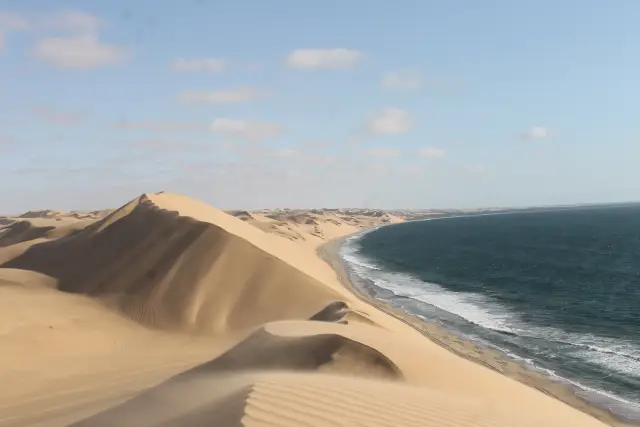
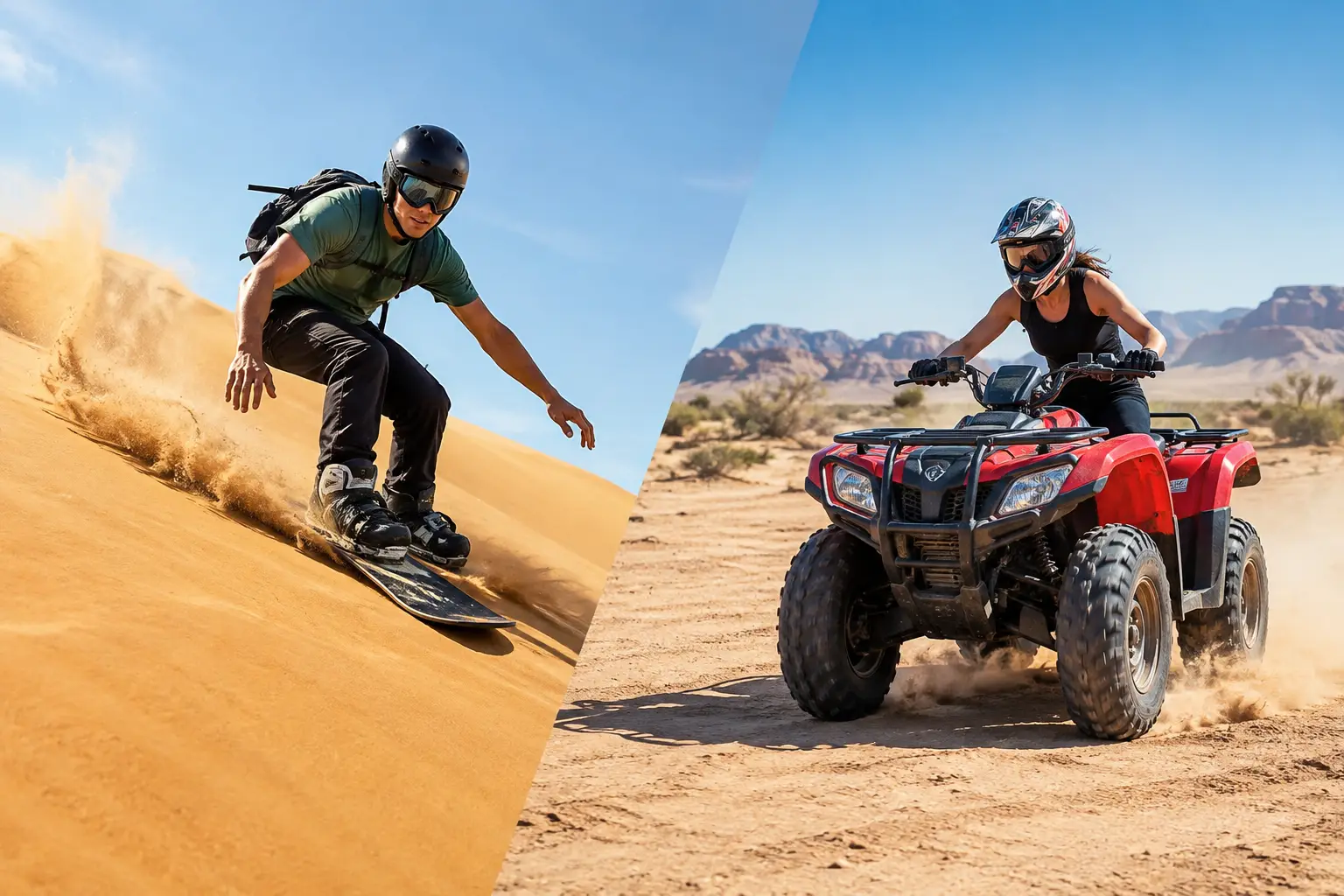
The dunes outside Swakopmund do not ask whether you came for a quiet view. They invite you to move. The real question is whether sandboarding or quad biking gives you the kind of desert story you want to take home: carving down a steep sand face with the wind in your ears, or powering across open terrain with a throttle in your hand.
Both are unforgettable Namibia adventures, and both suit first-timers far better than many travelers expect. But they deliver very different kinds of excitement. Your best choice depends on your appetite for speed, your group, the time you have, and whether you want to ride the dune itself or explore the desert around it.
Sandboarding or Quad Biking: The Big Difference
Sandboarding is direct, physical, and wonderfully simple. You climb or are positioned at the top of a dune, strap in or lie down depending on the style, then slide down a huge wall of soft sand. Stand-up sandboarding feels like a loose, sandy cousin of snowboarding. Lie-down boarding is faster, more immediate, and often brings out the loudest reactions from groups.
Quad biking is about range. Instead of taking one dramatic descent, you travel through a shifting landscape of dunes, open sand plains, and coastal desert scenery. You are behind the controls, following a guide through terrain that can look empty from a distance but reveals tracks, textures, ridgelines, and incredible views as you ride.
Think of sandboarding as a burst of pure dune action. Think of quad biking as a moving desert expedition with an adrenaline edge.
Choose Sandboarding If You Want the Fastest Rush
If your travel group keeps saying, “What is the most exciting thing we can do?” sandboarding may be your answer. There is very little waiting around once you are ready. You look down the dune, commit, and feel the slope pull you forward. It is the kind of experience that makes people laugh before they reach the bottom.
Sandboarding is especially good for travelers who want a memorable activity without needing to operate a vehicle. Beginners receive instruction, equipment, and guidance on how to ride safely. You do not need previous board-sports experience to enjoy it. Balance can help for stand-up boarding, but it is not a requirement for having a great time, particularly if you choose a lie-down run.
It also works well when your schedule is tight. A sandboarding session can fit neatly into a Swakopmund day alongside sightseeing, a meal in town, or another coastal activity. Couples and friend groups often love the shared challenge, while families can enjoy the excitement without needing everyone to be confident behind a motorized vehicle.
The trade-off is that sandboarding is more focused. You are there to ride dunes, not cover long distances through the desert. It can also be more physically demanding than it looks. Sand is soft, steep, and tiring to walk on, especially under the Namibian sun. The exhilaration is worth it, but bring water, wear sunscreen, and be honest about your energy level.
What Sandboarding Feels Like
The first few seconds can feel surprisingly calm. Then gravity takes over. Sand moves differently from snow or pavement, so every run has its own personality. You may glide smoothly, throw up a spray of sand, or finish with a tumble and a grin. That unpredictability is part of the fun.
For travelers who want a photo-worthy moment and a real rush without a long learning curve, sandboarding is hard to beat.
Choose Quad Biking If You Want to Explore More
Quad biking gives you a bigger sense of place. You are not simply looking at the dunes from a viewpoint. You are traveling through them, following routes selected for the terrain, the conditions, and the best scenic moments. The feeling of riding across Namibia’s coastal desert is powerful: wide skies, sculpted sand, Atlantic air, and a horizon that seems to stretch forever.
It is a strong choice for visitors who want a hands-on driving experience. You will receive a safety briefing and practical instruction before heading out, so beginners can get comfortable with the controls. A guided ride means you can focus on the fun while an experienced local guide manages the route and keeps the group moving safely through sensitive dune terrain.
Quad biking also suits groups with different confidence levels. One rider may enjoy a controlled cruise and the scenery, while another is excited by the climbs, turns, and changing surfaces. The route is still shared, but the experience feels personal because you are driving your own vehicle.
The trade-off is responsibility. You need to pay attention, follow instructions, and ride within your ability. Quad biking is not about racing across the dunes or treating the desert like an open track. The best rides are controlled, respectful of the environment, and led by people who understand how quickly conditions can change.
What Quad Biking Feels Like
A quad bike gives you a strong connection to the terrain. You feel the sand under the tires, the rise of a dune before you crest it, and the breeze as the landscape opens up in front of you. There is speed when appropriate, but there is also the satisfaction of learning how to move through a landscape that demands respect.
If you want more scenery, more distance, and the thrill of taking the handlebars yourself, quad biking is likely the better fit.
Consider Your Group Before You Book
The right choice often comes down to who is traveling with you. Sandboarding is excellent for energetic groups who want a shared laugh and a short, high-impact adventure. It is also appealing for travelers who do not want the pressure of driving a vehicle.
Quad biking can be ideal for couples, friends, and families with older children who want to spend more time outdoors and enjoy a guided ride together. It gives each rider a sense of independence while keeping the group on the same route. If someone in your party is nervous about driving, ask about passenger options or choose an activity that better matches their comfort level.
Age, fitness, weather, and individual confidence all matter. A good operator will explain participation requirements clearly rather than pushing someone into an activity that does not suit them. At Dominus Dune Tours, the point is to make the desert feel exciting and accessible, not intimidating.
Safety Is Part of the Adventure
Desert activities feel wild because the setting is wild. That is exactly why guidance matters. Dunes can be steep, visibility can shift, and soft sand requires different techniques than a normal road or trail.
For sandboarding, listen to the briefing, use the provided equipment correctly, and follow instructions on where to start and stop. Keep loose items secure, wear closed shoes if recommended, and expect sand to get everywhere. That is not a problem. It is part of the souvenir.
For quad biking, a proper helmet, clear controls briefing, and guide-led route are essential. Do not try to prove your confidence by riding beyond your skill level. Smooth throttle control, safe following distance, and attention to the guide will make the experience more enjoyable for everyone.
Responsible dune experiences also protect the landscape. Namibia’s desert may look endless, but it is not empty. Guided routes help reduce unnecessary impact and keep riders out of areas where access is restricted or conditions are unsuitable.
Can You Do Both?
Absolutely. For many adventure travelers, sandboarding and quad biking are not competing choices at all. They are two different ways to experience the same extraordinary environment. One gives you a rapid descent and a huge dose of laughter. The other gives you distance, discovery, and the satisfying feeling of navigating the desert under expert guidance.
If you have only one open slot in your itinerary, choose based on the memory you want most. Pick sandboarding if you want to say you flew down a Namibian dune. Pick quad biking if you want to say you rode through the desert with the horizon wide open ahead of you.
Do not overthink the choice until the adventure disappears into planning. Check the conditions, choose the activity that fits your group, and arrive ready for sand, sun, and a proper Namibian rush. The dunes will handle the rest.