
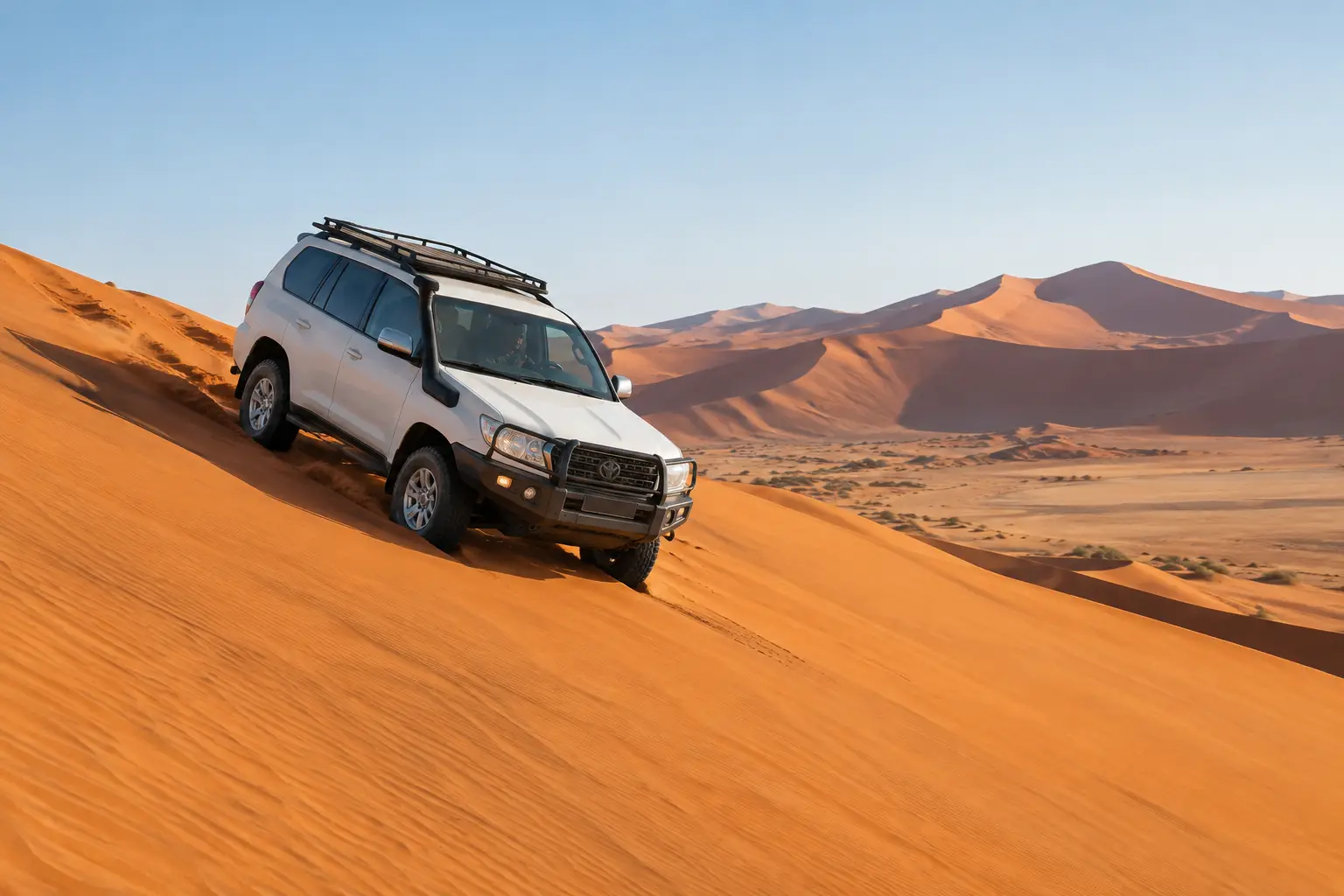
The view from a Namibian dune crest can stop you in your tracks: a clean drop of soft sand, a wide coastal plain, and tire tracks disappearing toward the Atlantic. But the moment you point a 4x4 downhill, the excitement needs to give way to control. To drive dune descents safely, you need more than confidence. You need the right line, the right tire pressure, and the discipline to let the vehicle work with the sand rather than fight it.
A dune descent can feel easy when conditions are perfect. The trouble is that desert terrain changes quickly. Wind reshapes ridges, soft pockets form without warning, and a slope that looked manageable from the top may hide a sharp drop or a cross-slope section below. Good dune driving is not about charging downhill. It is about reading terrain, making calm decisions, and knowing when to turn around.
Why dune descents demand respect
Descending a dune puts gravity on your side, but that does not mean the vehicle is automatically stable. Too much speed can make the vehicle slide sideways, bury its front end in soft sand, or send it over a hidden lip with more force than expected. Too little momentum can also be a problem if the route levels out in deep sand at the bottom.
The biggest risk is usually poor line choice. Dunes are not uniform ramps. Their windward side is generally firmer and more gradual, while the leeward slip face can be steep, soft, and unstable. On coastal routes near Sandwich Harbour and Langstrand, moisture, salt air, fog, and tides add another layer of changing conditions.
A capable 4x4 helps, but vehicle capability is never a substitute for local knowledge. If you are new to dune driving or unfamiliar with the route, a guided trip or a proper dune-driving lesson is the smart place to start. It gives you room to enjoy the epic landscape without learning every lesson the hard way.
Prepare before you roll over the crest
The best descent begins before the vehicle moves. Stop on stable ground short of the ridge, get out if it is safe to do so, and inspect the route. Never park right on a soft crest where the edge can collapse under the vehicle's weight.
Before committing, check four essentials:
- Your line: Look all the way to the bottom, not just over the first few meters. Watch for sharp lips, soft bowls, rocks, vegetation, tracks crossing the slope, and water near the beach.
- Tire pressure: Lowered tire pressure increases the contact patch and lets the tires float over soft sand. The correct pressure depends on the vehicle, tire type, load, and conditions, so use your operator's or rental provider's guidance rather than guessing.
- Drive settings: Engage low range where appropriate and select a low gear before starting down. Avoid changing gear mid-descent, when a sudden loss of drive or braking can unsettle the vehicle.
- Your exit plan: Know where you will go at the bottom. A descent that ends in very soft sand, tidal water, or an uphill climb requires a different approach from one that rolls out onto a firm track.
If the dune is blind, heavily rutted, exceptionally steep, or has no clear runout, do not test it just because other tire tracks are visible. Those tracks may be old, made by a lighter vehicle, or left by someone who got stuck.
How to drive dune descents safely with control
Once the line is checked, point the vehicle straight down the fall line. Keep the front wheels aimed in the direction you intend to travel and descend as directly as terrain allows. Driving diagonally across a steep face greatly increases the chance of sideways sliding or a rollover.
Select low range and a low gear before the crest. In many vehicles, engine braking helps regulate speed more smoothly than relying only on the brake pedal. Let the vehicle creep down under control, with gentle steering inputs and both hands firmly on the wheel.
Use the brakes lightly and progressively. Hard braking can lock the wheels, especially in loose sand, turning the tires into skates. If the vehicle begins to gather speed, ease on the brakes rather than stamping on them. Keep your inputs calm. A sudden steering correction can make a small slide worse.
Momentum has a place in dune driving, but it is not the goal on a descent. You are not trying to race to the bottom. You are carrying enough movement to stay predictable while keeping enough control to stop or adjust if the surface changes. On a steep slope, gravity provides plenty of momentum already.
Keep your eyes ahead, not directly over the hood. Looking farther down the slope helps you spot soft patches and gives you time to make minor corrections. If you feel the rear of the vehicle start to drift, reduce aggressive steering and guide the vehicle gently back into the direction of travel. Panicked inputs are what turn a manageable slide into a serious problem.
Read the sand, not just the slope
Sand color and texture can tell you a great deal. Darker, damp sand near the coast may be firmer on the surface, but do not assume it will stay firm beneath the tires. Dry, pale, windblown sand is often much softer, especially on the lee side of a dune or at the base where loose sand collects.
Fresh wind can erase tracks and build soft ridges overnight. Fog can flatten the light and make it difficult to judge slope depth or distance. In these conditions, slow down, inspect more often, and leave a bigger margin for error. This is especially true on narrow coastal corridors, where a wrong turn can place a vehicle too close to soft beach sand or a rising tide.
Never follow another vehicle blindly. The lead driver may have a different wheelbase, tire setup, vehicle weight, or skill level. Watch the line they take, but make your own assessment before you commit.
What to do if the vehicle slides or gets stuck
If your vehicle starts to slide sideways, stay calm. Avoid yanking the wheel uphill or downhill. Ease off the brakes if they are locked, steer gently in the direction of the slide where practical, and allow the tires to regain grip. The exact recovery depends on the slope, vehicle position, and surface, which is why prevention is always better than a dramatic correction.
If you lose forward progress at the bottom, do not keep spinning the tires. Wheelspin digs holes and makes recovery harder. Stop, assess the sand around all four tires, and reduce pressure only within safe recommended limits if that has not already been done. Clear sand away from the tires, use recovery boards if available, and recover in a controlled direction.
A safe desert vehicle should carry a compressor, pressure gauge, recovery boards, a rated recovery strap, a shovel, water, communication equipment, and basic first-aid supplies. More importantly, everyone using recovery gear needs to know how to use it. A recovery strap under tension can be dangerous when handled incorrectly.
Coastal dunes require extra planning
Namibia's coastal dune scenery is unforgettable because the desert meets the ocean in dramatic fashion. It also means drivers must respect tidal timing. A route that is open at low tide can become impassable as water rises, leaving no room between the surf and steep dunes.
Check conditions before departure, carry enough fuel for delays, and travel with another capable vehicle when self-driving in remote sand terrain. Tell someone where you are going and when you expect to return. Cell service can be unreliable, and a minor mechanical issue becomes a bigger problem when you are far from help.
Wildlife, fragile plants, and protected landscapes deserve the same respect as your vehicle. Stay on approved routes and established tracks. Creating new lines across sensitive desert terrain damages an environment that takes far longer to recover than a set of tire tracks suggests.
Build skill before you chase the steepest line
The best dune drivers look relaxed because they have practiced the basics: tire pressure, throttle control, hill approaches, controlled descents, and recovery. Start on smaller, open dunes with a clear runout. Learn how your specific vehicle responds before attempting steep faces or remote coastal routes.
For travelers who want the thrill without the guesswork, Dominus Dune Tours can show you how local terrain, tides, and changing sand conditions shape every decision behind the wheel. The reward is not simply reaching the bottom of a dune. It is reaching it smoothly, safely, and ready for the next unforgettable view.