
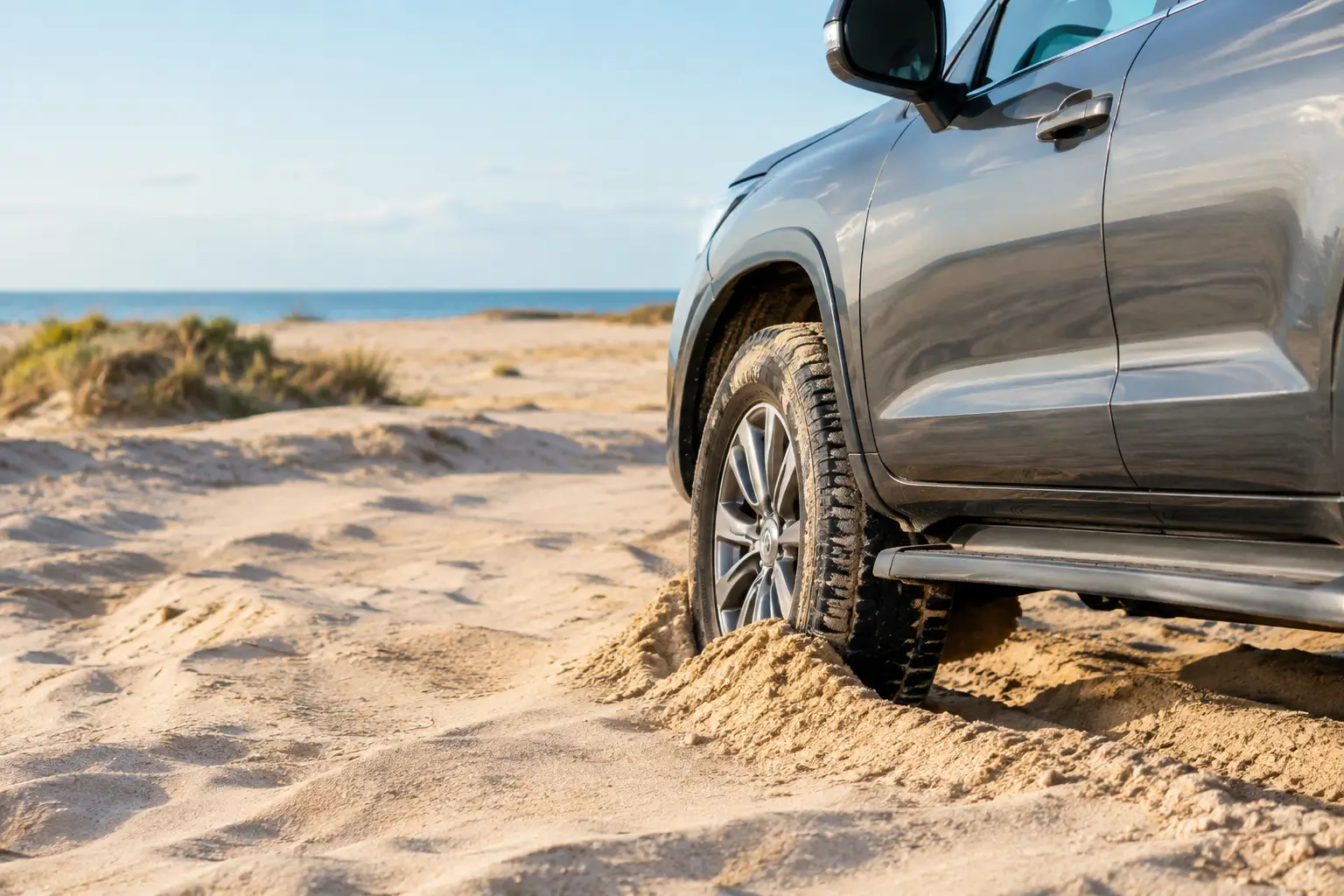
Soft sand looks inviting right up until your tires sink past the sidewalls and forward motion disappears. Knowing how to navigate soft sand turns a stressful moment into one of the best parts of a Namibia self-drive adventure. The key is not brute force. It is reading the surface, preparing your vehicle, and keeping your momentum smooth from the first soft patch to the firm ground beyond it.
Namibia’s coastal and desert terrain can change quickly. A route that feels solid in the morning may become loose and deep after wind, heat, or a busy day of vehicle traffic. Whether you are heading toward the dunes near Swakopmund, tackling a beach section, or exploring a remote sandy track, treat every soft section with respect.
Start Before the Sand Starts
The best sand driving decision is made before your wheels touch the soft stuff. Stop on firm ground, look ahead, and decide where you want the vehicle to exit. A soft section is much easier when you enter with a plan instead of reacting halfway through it.
Check that your 4x4 is in the correct drive mode. In most soft-sand situations, engage four-wheel drive high range before entering. High range gives you the wheel speed needed to carry momentum. Low range is useful when you need slow, controlled torque on steep dunes, in tight turns, or during a recovery, but it is not always the right choice for crossing a long flat stretch of loose sand.
Take a quick look at the track. Deep ruts, sharp drop-offs, and heavily churned-up lines are warning signs. If there is a firmer track beside them, use it. Avoid driving too close to the base of a dune where sand can be especially loose, and never assume another vehicle’s tracks are safe simply because they are visible.
Tire Pressure Is Your Biggest Advantage
Lowering tire pressure is one of the most effective ways to navigate soft sand. A softer tire creates a longer, wider footprint, helping the vehicle float over the surface instead of cutting down into it.
There is no single pressure that suits every vehicle, tire, load, and sand condition. As a practical starting point, many 4x4 drivers reduce pressure from normal road levels to around 18 to 22 psi for general sand driving. In very soft conditions, a further reduction may be needed, but go carefully and understand your vehicle’s limits. Lower pressures increase the risk of the tire coming off the rim, especially during sharp turns or sudden steering inputs.
Use a reliable tire gauge and carry an air compressor so you can reinflate before returning to pavement. Driving highway speeds on underinflated tires creates heat and can damage them. Sand pressure is for sand, not for the road home.
How to Navigate Soft Sand With Momentum
Momentum matters, but speed alone is not the answer. The goal is to maintain steady forward movement without spinning the tires or bouncing across the terrain. Think smooth throttle, gentle steering, and calm corrections.
As you approach a soft patch, choose a gear that keeps the engine in its useful power range. Apply enough throttle to move through the section confidently, then maintain it. If you lift off abruptly, turn sharply, or accelerate aggressively, the tires can dig in within seconds.
Keep your steering inputs light. Turning the front wheels acts like a brake in loose sand because the tires are trying to push sand sideways as well as forward. If you need to change direction, make a broad, gradual arc rather than a sudden correction.
Spacing also matters when traveling with other vehicles. Do not follow so closely that you are forced to stop in the softest section. Leave enough room to maintain momentum and enough distance to react if the vehicle ahead gets stuck.
Read the Terrain Like a Local
Sand is never just sand. Color, texture, shadows, and wind direction can all tell you what is under your tires.
Pale, dry, fluffy-looking sand is often softer than darker, compacted sand. Areas with fresh wind ripples may have a loose surface layer, while tracks that look smooth and polished may be firmer from repeated traffic. Near the coast, damp sand can be deceptively solid, but tide timing and changing beach conditions make it essential to know where you are going.
Dunes need their own approach. Drive straight up and straight down whenever possible. Crossing a steep dune face at an angle increases the risk of sliding sideways or rolling over. Before cresting a dune, slow down enough to check what lies on the other side. A sharp drop, another vehicle, or a hidden bowl can turn an exciting climb into a serious problem.
Never blindly charge over a dune crest. Ease up, assess the descent, and commit only when the line is clear. In unfamiliar terrain, local knowledge makes a major difference. Guided dune driving is not just about finding the scenic route. It is about understanding the ground beneath the wheels.
If You Feel the Vehicle Sinking, Stop Digging
The first sign of trouble is usually a loss of forward motion combined with spinning tires. Your instinct may be to press harder on the accelerator. Resist it. Wheelspin throws sand behind the tires and creates deeper holes, making recovery far more difficult.
Instead, ease off the throttle and stop. Keep the wheels as straight as possible. Get out only when it is safe to do so, then inspect the situation. Look for sand piled in front of the tires, check whether the vehicle is resting on its chassis, and decide whether a simple reverse along your entry tracks is possible.
A controlled recovery usually starts by clearing sand from around the drive tires. Place traction boards under the tires if you have them, and use a shovel to create a gentle ramp rather than a vertical wall of sand. Lowering tire pressure a little further may help, provided you stay within a sensible range for your wheels and tires.
When you are ready to move, use a light, steady throttle. If the vehicle does not move easily, stop again. Repeated attempts with spinning wheels rarely improve the situation. This is where having a second vehicle, proper recovery gear, and someone experienced in sand recovery is worth far more than a powerful engine.
Carry the Gear That Lets You Solve Problems
A self-drive desert route deserves more preparation than a standard road trip. At a minimum, carry a tire-pressure gauge, portable compressor, shovel, traction boards, recovery points rated for your vehicle, and a recovery strap designed for off-road use. Drinking water, sun protection, a charged phone, and a way to communicate outside cell coverage are equally important in remote areas.
Know how to use the equipment before you need it. A recovery strap attached to the wrong point can cause major vehicle damage or serious injury. Never stand near a tensioned strap, and keep bystanders well clear during any recovery.
It also helps to travel with another capable vehicle when your route is remote or technically demanding. Solo travel is possible in some areas, but the trade-off is simple: if you bury the vehicle far from help, a minor mistake can become a long wait in extreme heat.
Know When to Choose a Guide
Confident drivers can enjoy self-drive sand routes, but confidence is not the same as experience. Dune fields, coastal routes, and isolated tracks can involve changing conditions, restricted access areas, tide risk, and terrain that is difficult to judge from behind the wheel.
A guided experience gives you the thrill of the dunes without the pressure of route finding or recovery decisions. With Dominus Dune Tours, guests can experience Namibia’s dramatic sand landscapes with local guides who understand the lines, the conditions, and the safe places to push the adventure further.
For beginners, a dune driving lesson can be the ideal middle ground. You stay behind the wheel, learn the practical techniques, and build real confidence with expert support close by. For families and travelers who simply want the views, a guided 4x4 tour means more time watching the desert unfold and less time worrying about tire tracks.
Soft sand rewards preparation, patience, and a steady hand. Air down before the difficult section, keep your movements smooth, stop before wheelspin becomes digging, and never let pride make the next decision for you. The best desert drivers are not the ones who attack every dune. They are the ones who leave with great stories, a clean recovery kit, and a vehicle ready for tomorrow’s adventure.