
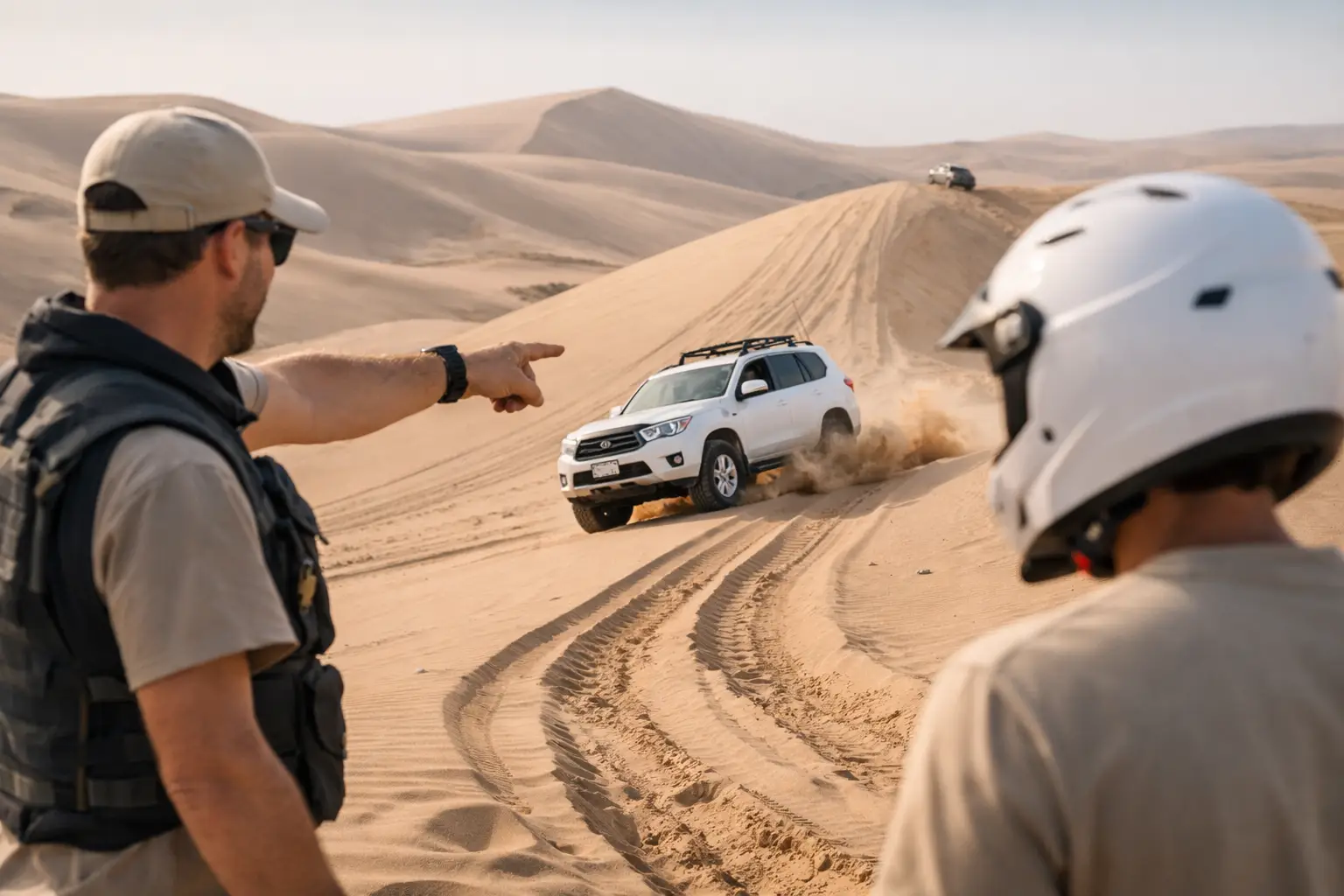
A 4x4 can feel completely different the moment its tires leave firm ground and meet soft Namibian sand. That is exactly what is a dune lesson: a hands-on, guided introduction to driving a 4x4 across dunes safely, confidently, and with a lot more control than trial and error allows.
It is not a race and it is not simply a scenic drive with someone else behind the wheel. A dune lesson puts you in the driver’s seat of a suitable 4x4, with an experienced instructor showing you how sand reacts, where momentum matters, when to slow down, and how to read the terrain ahead. You get the thrill of real dune driving while learning the practical habits that keep an adventure fun rather than stressful.
For self-drive travelers in Namibia, this can be one of the most useful experiences of the trip. For beginners, it is a confidence builder. For experienced off-road drivers who have only driven on dirt tracks, it is a chance to understand why soft coastal sand and steep dune faces demand a different approach.
What Is a Dune Lesson, Exactly?
A dune lesson is a practical off-road driving session focused on sand. Rather than learning from a manual or guessing your way through an unfamiliar landscape, you learn directly in the environment where the skills matter.
Your guide begins with the vehicle basics. You will learn why tire pressure changes are often needed for soft sand, how to select the right driving mode or gear range, and why smooth inputs make such a difference. From there, the lesson moves into the dunes, where you practice using momentum without charging blindly into a slope.
The terrain is part of the classroom. You will learn to identify a dune’s windward side, its sharper leeward side, soft patches, ridgelines, drop-offs, and safe routes between features. Sand can look inviting from a distance, but it changes quickly with wind, tide, traffic, and temperature. Reading it well is a skill.
A good lesson also covers what happens when things do not go as planned. Getting bogged down in sand is common, even for capable drivers. The goal is not to pretend it cannot happen. The goal is to recognize the warning signs early and know how to respond calmly.
What You Learn During a Dune Driving Lesson
Every route and lesson is shaped by conditions and the group’s experience, but the core skills stay consistent. You will learn to carry enough momentum to move through soft sand while avoiding harsh acceleration that digs the tires in. You will also practice gentle steering, controlled braking, and choosing a line before you commit to a climb or descent.
One of the biggest lessons is knowing when not to drive. A dramatic slope may make for an epic photo, but that does not automatically make it a safe route. An instructor helps you judge angles, crests, surface softness, and the space available to turn around. This is especially valuable in Namibia, where the dunes can be huge, isolated, and far less forgiving than a marked road.
You can also expect practical recovery guidance. Depending on the session and vehicle setup, this may include how to stop before you get deeply stuck, how to reverse along your tracks, where recovery points are located, and how recovery gear is used safely. Recovery equipment is useful, but it must be handled correctly. A rushed tow or poorly placed strap can damage vehicles and injure people.
Most importantly, you learn how to stay composed. Sand driving rewards calm decisions. Sudden moves, panic braking, and overcorrecting are usually what turn a small challenge into a difficult recovery.
The Difference Between Sand and Regular Off-Road Driving
A gravel road, rocky track, and dune field may all be called off-road terrain, but they do not drive the same way. On rock, traction and careful wheel placement often matter most. On sand, flotation and momentum are major factors. The tires need to stay on top of the surface as much as possible rather than digging downward.
That is why a vehicle can feel stable one moment and sluggish the next. A slight change in sand softness, a stop on an uphill section, or too much steering input can cost momentum quickly. A dune lesson teaches you to anticipate those changes instead of reacting after the vehicle is already struggling.
It also teaches restraint. More speed is not always the answer. On tight routes, near blind crests, or on steep descents, control matters more than power. The best dune drivers look smooth because they are planning ahead.
Who Should Take a Dune Lesson?
Dune lessons are ideal for travelers renting a 4x4 and planning to explore Namibia beyond paved highways. If you are considering a self-drive route near coastal dunes, desert tracks, or remote campsites, a lesson can make the rest of your trip feel far more manageable.
You do not need previous off-road experience. Beginners are often the people who benefit most because they learn the correct habits before picking up bad ones. Your instructor will start at a pace that suits you and gradually introduce more challenging terrain as your confidence grows.
It is also a great fit for couples, families, and groups where only one person expects to drive. Passengers gain a better understanding of what the driver is doing and why. That makes the whole vehicle team more useful when it is time to spot a route, watch a crest, or help with recovery.
More experienced drivers can benefit too. If you have driven 4x4 trails elsewhere, Namibia’s dune terrain still brings its own conditions. Coastal fog, changing sand, narrow ridges, and wide open desert landscapes require respect, even when you are comfortable behind the wheel.
Is a Dune Lesson Safe?
Dune driving involves real terrain, real gradients, and real consequences, so safety depends on professional guidance, suitable vehicles, and sensible decisions. A lesson should never be about taking unnecessary risks for a dramatic moment.
An experienced guide chooses an appropriate area and adjusts the route to the weather, sand conditions, and ability level of the drivers. You should receive clear instructions before attempting a slope, crossing a ridge, or driving into a softer section. The guide is there to coach you, not to pressure you.
Seat belts should be worn at all times, and vehicles need to be properly maintained and equipped for sand. Travelers should also bring water, sun protection, and closed shoes. Desert conditions can be intense even when the coastal air feels cool.
There is a trade-off worth understanding: the more technical the terrain, the more exciting the experience can feel, but it also requires more skill and more caution. A quality dune lesson balances both. You can have a memorable rush without treating the desert like a playground.
What to Expect From Your First Session
Your first session usually starts with an introduction to the vehicle and the route. You will discuss the controls, tire pressure, safety procedures, and communication signals. Then comes the fun part: putting those ideas into practice on sand.
At first, you may drive on gentler terrain to get a feel for the vehicle’s movement. Sand can make steering feel lighter and braking feel different, so a few simple runs help build familiarity. As you progress, you may practice climbs, descents, traverses, turns, and controlled stops in a safe setting.
Do not expect to become a desert expert in an hour. Dune driving is learned through observation and repetition, and conditions are never identical from one day to the next. What you can gain quickly is a strong foundation: how to assess a line, how to keep the vehicle moving smoothly, and when to ask for help before a situation becomes complicated.
At Dominus Dune Tours, dune driving lessons are designed to give visitors that foundation while still delivering the wide-open views, adrenaline, and unforgettable desert atmosphere that make Namibia special.
Frequently Asked Questions About Dune Lessons
Do I need to bring my own 4x4?
That depends on the lesson arrangement. Some travelers take a lesson in their own or rented 4x4, while others use an operator-provided vehicle. If you are using a rental, check its off-road and insurance conditions before booking. Not every rental agreement permits dune driving.
Can beginners do a dune lesson?
Yes. A beginner-friendly lesson starts with the basics and builds up gradually. You do not need to be an expert driver, but you should be comfortable operating a vehicle and following instructions closely.
Will I get stuck in the sand?
It is possible, because sand is unpredictable. But learning how to avoid getting stuck, and how to recover safely if it happens, is part of the value of the lesson. A controlled learning environment is far better than facing your first bog-down alone in a remote area.
How long does a dune lesson take?
The length varies by route, conditions, and the level of instruction. Short sessions can cover essential techniques, while longer experiences allow more time for practice and scenic exploration.
The desert rewards preparation, patience, and a sense of adventure. Take the lesson, listen to the sand beneath the tires, and you will leave with more than photos - you will have the confidence to meet Namibia’s dunes with respect and excitement.