
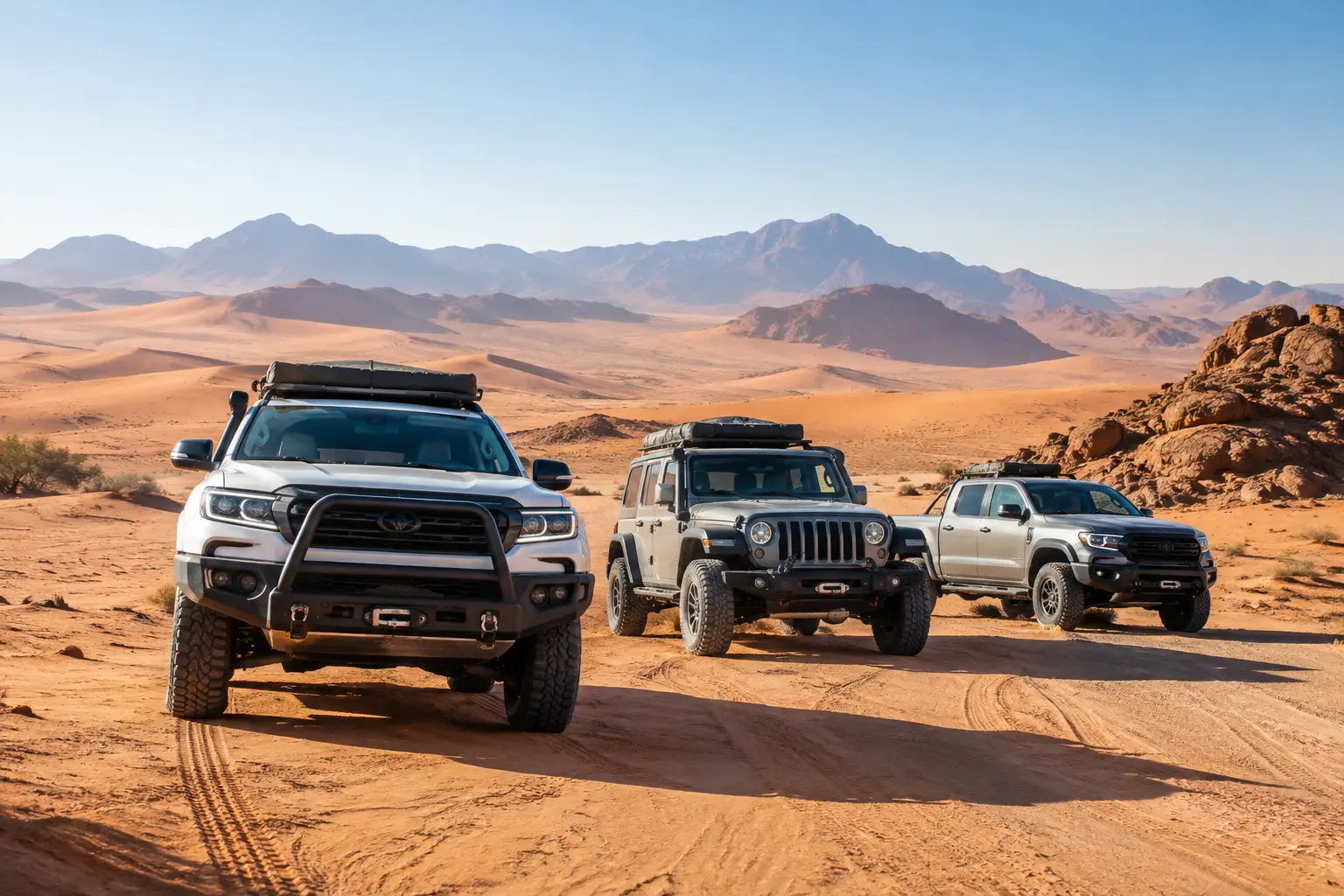
The first soft patch of sand can answer which vehicle suits desert tracks faster than any rental-car brochure. A vehicle that feels perfectly capable on a paved road can sink to its axles when the surface turns loose, steep, and constantly changing. In Namibia, choosing the right ride is not about looking adventurous in the parking lot. It is about having the traction, clearance, control, and preparation to experience the dunes with confidence.
For most travelers heading beyond the highway, a proper 4x4 is the clear choice. But not every 4x4 is equally suited to every route. The right vehicle depends on whether you are tackling firm gravel, corrugated desert roads, deep coastal sand, or towering dune faces near places such as Sandwich Harbour and Sossusvlei.
Which vehicle suits desert tracks best?
A high-clearance, low-range 4x4 with all-terrain tires is the best all-around vehicle for Namibia's desert tracks. Think of a capable SUV or pickup with true four-wheel drive, not simply an all-wheel-drive vehicle with a rugged-looking badge.
Low-range gearing matters because dunes are not just about speed. You need controlled power when climbing, engine braking when descending, and the ability to keep moving through soft sand without spinning the wheels. High ground clearance matters too. Deep ruts, sharp crests, and uneven tracks can quickly catch low bumpers, exhaust components, or underbody panels.
Popular desert-ready choices include vehicles in the Land Cruiser, Fortuner, Prado, Hilux, Ranger, Defender, and similar categories. The badge matters less than the setup. A well-maintained, properly equipped 4x4 with an experienced driver will outperform a larger vehicle on unsuitable tires every time.
For a guided dune adventure, the vehicle is part of the experience. At Dominus Dune Tours, the focus is on capable 4x4s and local route knowledge, so guests can enjoy the thrill of the terrain without needing to judge every blind dune crest themselves.
Why a standard SUV is not always enough
Many standard SUVs are comfortable, fuel-efficient, and perfectly suitable for town driving and maintained gravel roads. Some can handle hard-packed dirt tracks with care. That does not make them suitable for deep sand.
All-wheel drive is designed primarily to improve road grip by automatically distributing power between wheels. It can be useful on wet pavement or lightly uneven roads, but it usually lacks low-range gears, enough ground clearance, and the durable recovery points needed for serious dune driving. Long stretches of soft sand can also overheat some systems.
A two-wheel-drive vehicle is even more limited. It may manage firm desert roads, but once it loses momentum in loose sand, recovery can become difficult and expensive. A vehicle getting stuck is not merely an inconvenience in remote terrain. It can block a route, expose passengers to heat, and place unnecessary pressure on local recovery teams.
If your plan is limited to scenic roads and established viewpoints, ask your rental provider exactly where the vehicle is permitted to go. If dunes, beach routes, or isolated tracks are on the agenda, choose a genuine 4x4 or travel with a specialist guide.
The features that make a desert vehicle capable
Desert driving is a combination of vehicle capability and driver technique. Still, the following features give you a far better starting point:
- Low-range four-wheel drive for steady torque, controlled climbs, and safer descents.
- High ground clearance to protect the underside on rutted tracks and sharp dune crests.
- All-terrain tires with strong sidewalls and a tread pattern suited to gravel and sand.
- A full-size spare tire because punctures can happen far from the next service station.
- Front and rear recovery points for safe towing or extraction if the vehicle becomes stuck.
- A compressor and tire-pressure gauge for lowering and restoring tire pressures correctly.
Traction control, hill-descent control, and rear differential locks can all help, but they do not replace skill. In fact, some electronic systems can work against you in very soft sand by cutting power when wheelspin is needed to maintain momentum. Experienced drivers know when to use these features and when to switch them off.
Tires matter more than many drivers expect
Tires are the vehicle's only contact with the ground. On desert gravel, they need to resist punctures and handle heat. On sand, they need a broad footprint that spreads the vehicle's weight instead of cutting down into the surface.
Lowering tire pressure is one of the most effective ways to improve flotation in sand. The exact pressure depends on the vehicle, tire size, load, and sand conditions, so there is no single number that suits every situation. Drop pressure too little and you risk rolling a tire off the rim or damaging its sidewall. Leave it too high and the vehicle may dig in almost immediately.
Always reinflate tires before returning to faster gravel or paved roads. A compressor is not an optional extra for a self-drive sand route. It is essential equipment.
Match the vehicle to the track
Namibia's terrain can change dramatically within a single day. A route that begins on smooth pavement may lead to corrugated gravel, dry riverbeds, salt flats, and soft dune sand. Matching the vehicle to the conditions keeps the adventure exciting for the right reasons.
Gravel roads and long-distance touring
For long gravel-road journeys, a comfortable high-clearance 4x4 is ideal, especially if you are carrying luggage, camping gear, or traveling as a family. The priority here is tire durability, suspension condition, fuel range, and a full-size spare. Corrugations can shake a vehicle hard, so reduce speed and never assume a straight road is a safe road.
A 4x2 pickup or SUV may be enough for some established gravel routes, but a 4x4 adds flexibility when conditions deteriorate after wind or rain. It also provides a margin of safety if you encounter sandier side tracks.
Soft dunes and coastal sand
For deep sand, steep dunes, and coastal terrain, choose a true 4x4 with low range, suitable tires, and a driver who understands momentum. Coastal dunes can look deceptively smooth, but the surface changes with tides, wind, and temperature. A safe route one day can be unstable or impassable the next.
This is where guided driving makes a major difference. Local guides read the sand, know the legal access areas, understand tidal timing, and recognize when a dune face should not be attempted. You get the full adrenaline rush without turning a spectacular day into a recovery operation.
Self-drive routes with remote stretches
If you are planning a self-drive desert trip, choose a vehicle with enough fuel range, water storage, a spare tire, recovery gear, navigation support, and reliable communication. Do not rely on cell service in remote locations. Let someone know your planned route and expected arrival time, especially if you are traveling outside busy tourism areas.
A larger vehicle can carry more equipment, but size has trade-offs. Heavy vehicles can sink more deeply in soft sand, require wider turning space, and feel less predictable over sharp dune crests. The best desert vehicle is capable without being unnecessarily bulky.
Vehicle setup is only half the job
Even the best-equipped 4x4 can get into trouble with poor technique. Desert driving requires smooth inputs, measured momentum, and constant attention to the surface ahead. Sudden braking on a climb, aggressive steering, or stopping in the wrong place can leave you stuck within seconds.
Before entering sand, engage the appropriate drive mode or four-wheel-drive setting while on firm ground. Reduce tire pressure as needed, secure loose luggage, and remove anything that could become dangerous on steep angles. Keep both hands on the wheel, look well ahead, and avoid following another vehicle so closely that you lose sight of changing terrain.
Never drive blindly over a dune crest. The far side may drop sharply, hide another vehicle, or lead into an unsafe slope. Stop where safe, assess the line, and descend with control. If you are new to dune driving, a lesson or guided excursion is the smart way to build skill while enjoying the epic scenery.
Choose confidence, not just capability
The vehicle that suits desert tracks is the one that matches your route, your experience, and the day’s conditions. For serious sand and dunes, that means a high-clearance 4x4 with low range, good tires, recovery readiness, and a driver who knows how to use it.
If you would rather spend your time watching the Atlantic meet the dunes, carving across open sand, and taking photos from places most travelers never reach, leave the route decisions to people who know the desert by heart. The right vehicle gets you there. The right guidance turns the drive into a memory that lasts a lifetime.